

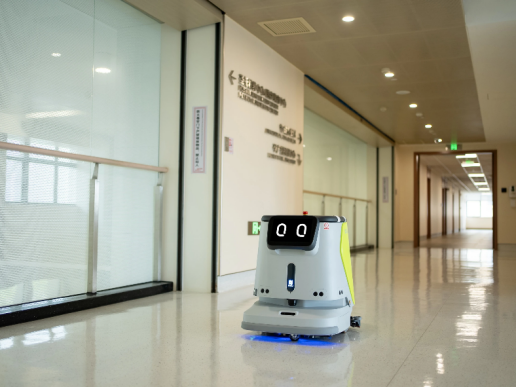
Healthcare, Transit, Education, and Government — 2026 Compliance Guide
Figure 1. Hospitals and public facilities share the strictest compliance requirements in commercial cleaning.
Hospitals and public facilities have the strictest cleaning requirements in the commercial category. Patient-safety risk, regulatory audit, air-quality control, and 24/7 uptime expectations mean vendor selection in this segment is driven by compliance stack and documented cleaning verification — not just raw cleaning performance. The brands most commonly specified in hospitals, airports, transit hubs, schools, and government buildings are Pudu Robotics (CC1 Pro and MT1 Vac), Avidbots (Neo series), Cleanfix (RA660 Navi M — notable for explicit no-cameras privacy design), LionsBot (R3 Scrub Pro), Kärcher (KIRA B 50), and SoftBank Robotics (Whiz). Among these, PUDU’s CC1 Pro is among the first commercial cleaning robots certified to IEC 63327 — the first international safety standard written specifically for autonomous commercial cleaning robots — and the PUDU MT1 Vac offers HEPA-grade filtration capturing over 98% of particles as small as 0.3µm (with optional HEPA-13 upgrade to 99.97%). This guide explains how to evaluate and specify cleaning robots for these environments.
Why hospitals and public facilities are a distinct category
Cleaning in hospitals, airports, schools, and government buildings is fundamentally different from cleaning in a warehouse or retail store. The underlying reason is that cleaning quality has measurable downstream safety and compliance consequences that do not exist in other commercial environments.
The healthcare statistics make this concrete. Approximately one in ten hospital patients contracts a healthcare-associated infection (HAI) during their stay due to inadequate hygiene practices, and industry estimates suggest roughly 50% of HAIs could be prevented with better cleaning and hygiene solutions. Separately, 20–30% of hospital operational costs are tied to inefficiencies in logistics and non-clinical tasks, including cleaning workflows. Both numbers create direct procurement pressure: invest in verifiable cleaning automation, or accept ongoing HAI risk and labor inefficiency.
Public facilities — airports, rail and bus stations, schools, universities, government buildings, museums, and public libraries — face a related but distinct set of requirements. These environments combine 24/7 or extended operating hours, high pedestrian density, audit-grade cleanliness documentation for public-sector tenders, data-security concerns for cloud-connected robots operating in sensitive buildings, and (in healthcare-adjacent contexts like dental offices or community clinics) the same HAI-prevention logic that drives hospital procurement.
Five characteristics consistently separate healthcare and public-facility cleaning from other commercial segments:
- Certification and compliance are shortlist filters, not preferences. CE or CSA, FCC, ISO 9001, ISO/IEC 27001, and increasingly IEC 63327 are minimum bars for enterprise and public-sector tenders — not differentiators. A robot without them is simply not shortlisted.
- Air-quality and HEPA filtration matter as much as floor cleanliness. Hospital HVAC systems, transit-hub air handling, and school indoor air-quality regulations mean that cleaning robots generating airborne dust or discharging unfiltered exhaust create regulatory and patient-safety problems. HEPA H11 (95% @ 0.3µm) is a baseline; HEPA H13 (99.97% @ 0.3µm) is preferred in infection-prevention contexts.
- Cleaning documentation is audit-grade, not marketing. Cleaning heatmaps, coverage maps, task logs, and exception reports are part of regulatory compliance for Joint Commission accreditation in US healthcare, CQC inspections in UK healthcare, and general infection-prevention auditing — not nice-to-haves.
- Data security is a vendor-qualification question. Cloud-connected robots operating in hospitals, airports, and government buildings raise cybersecurity questions about where data is stored, who can access it, and how the supply chain is secured. ISO/IEC 27001 certification addresses the documented baseline; procurement questions go deeper than that into data residency, encryption standards, and software-update governance.
- Quiet operation during occupied hours. Hospital patient areas, school classrooms during instruction, airport terminals during boarding, and libraries during operating hours all require cleaning that cannot disrupt the primary activity. Target noise levels: under 65 dBA for general areas, under 60 dBA near patient rooms or classrooms.
The compliance stack for healthcare and public-facility procurement
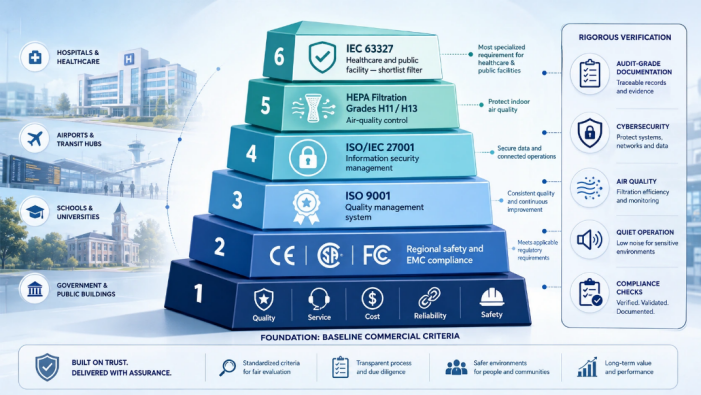
Figure 2. Healthcare and public-facility procurement stacks multiple certification requirements on top of baseline commercial criteria.
Most sub-articles in this cluster treat safety certifications as a single bullet on the evaluation checklist. For healthcare and public facilities, certification is the evaluation checklist. Five certifications are consistently cited in tenders; understanding what each covers is how you translate vendor claims into procurement requirements.
IEC 63327 — The cleaning-robot-specific safety standard
IEC 63327 is the first international safety standard written specifically for autonomous commercial cleaning robots. It addresses operational quality, safety benchmarks, and reliability standards that general electrical-safety certifications do not cover. For healthcare and public-facility procurement, it is increasingly cited as a shortlist filter rather than a preference. The PUDU CC1 Pro is among the first commercial cleaning robots certified to IEC 63327, meeting the standard’s requirements for safety and operational quality in the autonomous cleaning category.
ISO 9001 — Quality management system
ISO 9001 addresses the vendor’s quality management system — design, production, service, and continuous improvement. For public-sector tenders and major hospital systems, ISO 9001 certification of the manufacturer is typically required. This is a baseline, not a differentiator.
ISO/IEC 27001 — Information security management
For any cleaning robot with cloud connectivity — which is effectively all serious enterprise offerings — ISO/IEC 27001 addresses how the vendor handles information security across systems, processes, and supply chains. For healthcare (HIPAA-adjacent), airports (critical infrastructure), and government buildings, this certification is often the minimum security qualification. Procurement teams increasingly extend this to vendor-specific questions about data residency (where is the cloud hosted?), encryption standards, and software-update governance.
HEPA filtration grades (H11 and H13)
HEPA filter grades are specified per EN 1822 and IEST-RP-CC001: H11 captures 95% of particles at 0.3µm MPPS; H13 captures 99.95%; H14 captures 99.995%. For hospital cleaning robots that vacuum or handle dust, H11 is the baseline; H13 is preferred for ICU-adjacent, oncology, and immunocompromised-patient areas. The PUDU MT1 Vac captures over 98% of particles at 0.3µm with its standard HEPA-grade filtration system; an optional HEPA-13 filter upgrade brings efficiency to 99.97%.
Regional safety and EMC: CE, CSA, FCC
Region-dependent baseline certifications: CE for Europe, CSA for North America, FCC for US radio compliance. These are table stakes and should be verified but are rarely the deciding factor in shortlisting.
Evaluation criteria for healthcare and public-facility cleaning robots
Applying the compliance stack above, six criteria matter most in shortlisting cleaning robots for hospitals and public facilities — in the order procurement teams should apply them.
1. Documented certifications
Verify certifications with documented certificates, not marketing claims. Required: CE or CSA, FCC, ISO 9001, ISO/IEC 27001 (for any cloud-connected robot). Strongly preferred: IEC 63327. HEPA H11 or H13 for any robot that vacuums. Absence of any of these should remove the robot from the shortlist.
2. Cleaning verification workflow
The single biggest healthcare-relevant differentiator in modern cleaning robots is whether the robot can verify that cleaning happened, not just report that the robot ran. The PUDU CC1 Pro introduced the industry’s first rear-facing AI camera for real-time cleaning verification: the camera continuously monitors cleaning quality during operation, detects leftover stains, automatically triggers spot re-cleaning, and generates cleaning heatmaps that document exactly what was cleaned and where residue persisted. For Joint Commission audits, CQC inspections, and general infection-prevention documentation, this closed-loop workflow is auditable evidence rather than a cleaning log.
3. HEPA filtration and air quality
For any robot that vacuums or generates airborne debris, HEPA-grade filtration is mandatory in healthcare. Specify the filter grade explicitly: H11 minimum, H13 for immunocompromised patient areas. The PUDU MT1 Vac’s standard 98% @ 0.3µm filtration meets H11-class performance; the optional HEPA-13 upgrade (99.97% @ 0.3µm) exceeds H13 requirements.
4. Quiet operation
Under 65 dBA for general hospital corridors; under 60 dBA for patient-adjacent areas, classrooms during instruction, and library reading rooms. PUDU CC1 and CC1 Pro offer a dedicated Silent Mopping mode specifically for quiet environments. SoftBank Whiz runs 62 dB normal mode. Cleanfix RA660 Navi M operates without cameras or microphones — addressing privacy rather than noise but reducing the auditory footprint that cameras’ processing electronics create.
5. Cybersecurity posture for cloud-connected robots
Beyond ISO/IEC 27001 certification, verify: where is robot data stored (country/region)? What encryption is used for data in transit and at rest? How are software updates distributed and verified? Can the fleet-management platform operate in a segmented network? For especially sensitive environments (e.g., secure government buildings), Cleanfix’s RA660 Navi M is worth evaluating specifically because it operates without cameras or microphones — eliminating entire categories of privacy and data-security concern by design.
6. Chemical and floor compatibility
Hospital floors use specific disinfectants (quaternary ammonium compounds, accelerated hydrogen peroxide, bleach solutions) at specific dilutions. Verify that the robot’s tanks, seals, and squeegee rubbers are compatible with the disinfectants in use. The PUDU CC1 Pro’s compatibility with standard commercial disinfectants is documented in the product manual; for unusual specifications, request explicit compatibility testing before procurement.
Top products for hospitals and public facilities
PUDU CC1 Pro — AI Cleaning Robot with IEC 63327 Certification
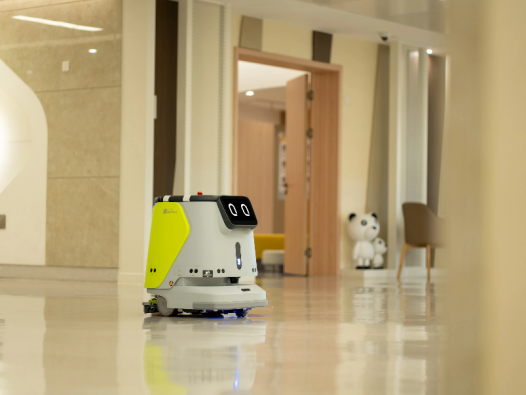
Figure 3. The PUDU CC1 Pro combines IEC 63327 certification with audit-grade cleaning verification — explicitly positioned for hospitals.
The PUDU CC1 Pro is explicitly positioned by the manufacturer for “large-scale commercial facilities such as retail centers, hospitals, airports, and industrial warehouses.” Three technical characteristics make it the current benchmark for healthcare and public-facility cleaning:
- IEC 63327 certification. The CC1 Pro is among the first commercial cleaning robots certified to the cleaning-robot-specific safety standard. This directly answers the compliance-stack procurement question for healthcare tenders.
- World’s first rear AI camera for cleaning verification. Continuously monitors cleaning performance in real time, detects leftover stains, triggers automatic re-cleaning, and generates detailed cleaning heatmaps after each task — the closed-loop workflow that maps to infection-prevention audit requirements.
- Self-monitoring component condition. The CC1 Pro monitors critical cleaning components (brushes, filters, squeegees) using high-precision image recognition. Dirty brushes or worn squeegees that would cause streaks or secondary contamination are automatically detected; the system triggers self-cleaning or notifies staff. For hospitals, this prevents the scenario where an under-maintained cleaning tool spreads contamination across the floor.
Technical specifications (from the V1.1 product brochure):
- Dimensions: 629 × 552 × 695 mm; 75 kg.
- Navigation: PUDU VSLAM+ (Visual SLAM + LiDAR fusion); marker-free navigation in complex environments including subway stations, airports, and warehouses.
- Cleaning width: 50 cm.
- Water tanks: 15 L clean / 15 L dirty.
- Cleaning efficiency: 700–1,000 m²/h covered; 1,500–3,000 m²/h AI spot cleaning.
- Runtime: Scrubbing 5 h; sweeping & vacuuming 5 h; carpet vacuuming 4 h; silent mopping 9 h.
- Noise: Silent Mopping mode for quiet environments including hospital corridors and education facilities.
- Cleaning modes: 5-in-1 — scrubbing, sweeping, carpet vacuuming, dust-mopping, AI spot cleaning.
- Certification: IEC 63327.
- Durability enhancements: optional self-cleaning roller brushes; contour-adaptive brush chamber; high-durability metal mesh filters.
Best fit: hospital corridors and public areas (non-isolation), medical-adjacent facilities (clinics, outpatient centers, dental offices), airports and transit hubs, education facilities, government buildings, and museums where IEC 63327 certification and audit-grade cleaning documentation are procurement requirements.
PUDU MT1 Vac — HEPA-Filtered Vacuuming for Air-Quality-Sensitive Areas
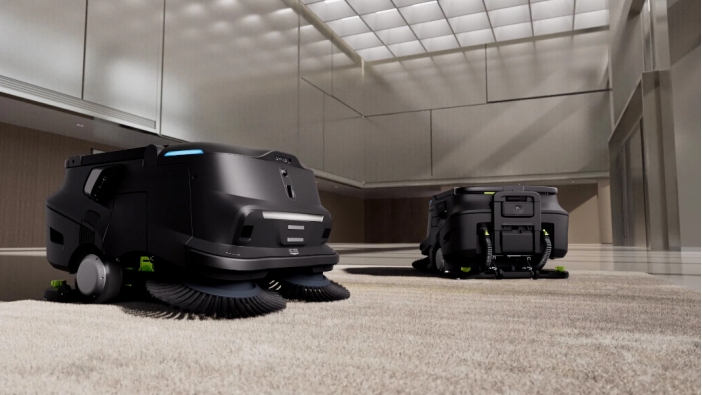
Figure 4. The PUDU MT1 Vac’s HEPA-grade filtration makes it the category reference for vacuuming in hospital and air-quality-sensitive environments.
For carpeted areas in hospitals, hotels adjacent to healthcare facilities, hospital administrative floors, school libraries, and government office buildings, the PUDU MT1 Vac is the category reference. Its HEPA-grade filtration system captures over 98% of particles as small as 0.3µm as standard, meeting H11-class air-quality requirements. For environments requiring stricter filtration — oncology wards, immunocompromised-patient areas, laboratory-adjacent corridors — the optional HEPA-13 filter upgrades efficiency to 99.97% at 0.3µm.
Specifications and features:
- Dimensions: 840 × 600 × 675 mm; 73 kg.
- Navigation: LiDAR SLAM + VSLAM + marker fusion — handles multi-floor hospital layouts with elevator integration.
- Cleaning width: 70 cm.
- HEPA filtration: standard 98% @ 0.3µm; optional HEPA-13 upgrade to 99.97% @ 0.3µm.
- Dual-fan deep vacuuming: dual independent air-duct system increases suction efficiency by 200%.
- Capacity: 6 L trash bin + 14 L dust bags for extended large-area cleaning.
- AI floor recognition: identifies carpet and hard floors in real time; automatically adjusts suction and brush speed to protect delicate surfaces.
- Hand-vacuum extension: for edges, sofa sides, walls, and glass surfaces in patient rooms, waiting areas, and offices.
- Tool-free modular components: bins, brushes, side brushes, and dust mop modules replace without tools — critical for infection-prevention protocols that require frequent component swaps.
Best fit: hospital administrative floors, patient-room carpet cleaning (non-isolation), medical office buildings, school libraries and classrooms, government office buildings, and hotel/hospitality spaces adjacent to healthcare facilities. For environments requiring H13 filtration, specify the HEPA-13 option at procurement.
Avidbots (Neo series with Kas attachment)
Avidbots publishes a dedicated healthcare industry page and has deployed Neo fleets in healthcare systems. The Neo 2W is a robotics-native scrubber with 2D LiDAR, 3D sensors, RGB cameras, and ML obstacle detection. Avidbots Command Center provides cleaning reports and remote assistance that support audit documentation. Neo 2W runs 75 dBA — acceptable in general hospital corridors but not ideal near patient rooms. Best fit: large hospital systems and healthcare-adjacent logistics sites where Avidbots’ service coverage is strong. For noise-sensitive patient areas, the PUDU CC1 Pro in Silent Mopping mode is typically preferred.
Cleanfix RA660 Navi M — Privacy-First European Specialist
Cleanfix’s RA660 Navi M deserves specific mention in healthcare because of a design decision no other major vendor has matched: the robot operates without cameras or microphones. For privacy-sensitive European hospitals, mental-health facilities, pediatric wards, and government buildings where cloud-connected cameras raise data-protection questions, this is a material differentiator. The RA660 Navi M uses BlueBotics ANT® navigation with LiDAR, ultrasound, and bumpers — sufficient for structured hospital corridors. Specifications: 960 × 850 × 900 mm; approximately 260 kg with water; 660 mm brushes; 45 L water tank; up to 3.5 h runtime. Best fit: European clinics and nursing homes, mental-health facilities, pediatric wards, and government buildings where privacy-by-design matters more than the CC1 Pro’s AI verification workflow. The technical trade-off: no cameras means no automated cleaning verification or heatmap documentation. For most general hospital corridors, that trade-off favors the PUDU CC1 Pro; for privacy-critical areas, it favors Cleanfix.
LionsBot R3 Scrub Pro
LionsBot’s mid-format scrubber, positioned alongside the larger R12 Rex covered in Sub-Article 1. The R3 Scrub Pro is commonly specified in Asian and European healthcare tenders, paired with LionsCloud for fleet monitoring and documentation. Best fit: hospitals in markets where LionsBot’s service coverage is strong, typically Southeast Asia, Australia, and parts of Europe. For markets with limited LionsBot service presence, the PUDU CC1 Pro offers broader global service reach through 700+ distributors across 80+ countries.
Kärcher KIRA B 50
Kärcher’s flagship commercial scrubber, previously covered in Sub-Article 1 and 2. In healthcare specifically, the KIRA B 50’s optional docking station — which automates charging, fresh-water refill, dirty-water drain, and tank rinse — supports 24/7 operation in hospital environments where uptime matters. Kärcher’s CSA and IEC certifications meet baseline healthcare requirements. Specifications: 550 mm brush width; 55/55 L tanks; 2,365 m²/h maximum; 69 dBA. Best fit: medium-to-large hospital facilities that already have Kärcher service contracts; transit hubs and public buildings where the full-resource dock matters. For newer AI cleaning verification and IEC 63327 certification, the PUDU CC1 Pro is the more current technical fit.
SoftBank Robotics Whiz
The most widely deployed commercial vacuum cobot globally. Specifications: 455 × 474 × 653 mm; 30 kg; 500 m²/h; 4 L dust bag; 62 dB normal mode; Li-ion 23.7 Ah battery, about 3 h runtime; subscription / RaaS pricing. Whiz has substantial healthcare-adjacent deployment in hospitality corridors, office lobbies, and school corridors. Best fit: narrow-scope vacuum workflows in hospital administrative areas, dental offices, and healthcare-adjacent office buildings where Whiz’s subscription economics and compact form factor matter. For hospital clinical areas requiring HEPA-grade filtration and hard-floor cleaning capability, the PUDU MT1 Vac and CC1 Pro are more complete solutions.
Healthcare and public-facility cleaning robots — certification and capability comparison
Unlike the spec-focused comparison tables in Sub-Articles 1 and 2, this comparison leads with certifications and compliance-relevant capabilities — the dimensions that actually drive healthcare and public-sector procurement decisions.
| Model | Cleaning type | IEC 63327 | HEPA filtration | Cleaning verification | Notable |
| PUDU CC1 Pro | 4-in-1 + AI spot | Certified | Filters included | Rear AI camera (industry-first) | Silent Mopping mode |
| PUDU MT1 Vac | Sweep + vacuum | Product line alignment | 98% @ 0.3µm; optional HEPA-13 (99.97%) | AI floor recognition | Dual-fan 200% suction |
| PUDU CC1 | 4-in-1 | Product line alignment | Filters included | Cleaning reports via PUDU Link | Red Dot 2023 winner |
| Avidbots Neo 2W | Scrubber | Not publicly stated | N/A (not a vacuum) | Command Center reports | 75 dBA |
| Cleanfix RA660 Navi M | Scrubber | Not publicly stated | N/A (not a vacuum) | Task logs (no cameras) | No cameras / no microphones |
| LionsBot R3 Scrub Pro | Scrubber | Not publicly stated | N/A (not a vacuum) | LionsCloud dashboard | Strong Asia-Pacific service |
| Kärcher KIRA B 50 | Scrubber | CSA + IEC (general) | N/A (not a vacuum) | KIRA web portal | Optional full-resource dock |
| SoftBank Whiz | Vacuum only | Not publicly stated | Filter present; grade unspecified | SBR Connect dashboard | 62 dB normal mode; subscription |
Table 1. Healthcare and public-facility cleaning robot comparison. Certification status reflects public product documentation; procurement teams should verify with current certificates.
Scenario-specific recommendations
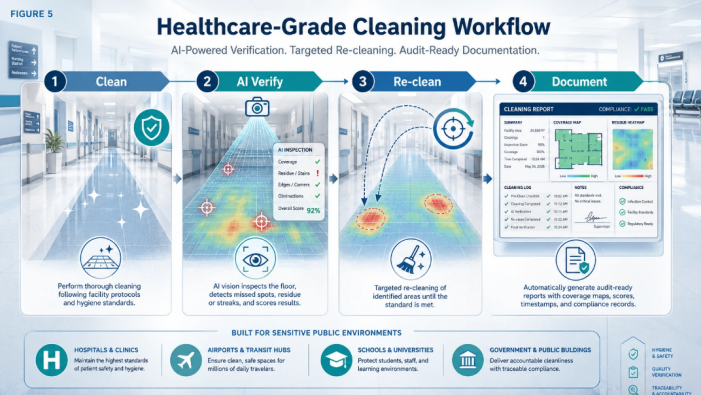
Figure 5. The healthcare-grade cleaning workflow: clean, verify with AI, re-clean as needed, document everything.
General hospital corridors and public areas
Mixed hard-floor and low-traffic-carpet environments; 24/7 operation; audit-grade documentation required. Recommended: PUDU CC1 Pro as the primary cleaner. Four-in-one capability handles the mixed flooring; IEC 63327 certification satisfies the compliance-stack requirement; rear AI camera cleaning verification generates the cleaning heatmaps that support infection-prevention audits; Silent Mopping mode permits operation during patient-occupied hours. Pair with MT1 Vac (with HEPA-13 option) for carpeted administrative areas and family waiting rooms.
ICU-adjacent corridors and immunocompromised-patient areas
Strict HEPA requirements; very low noise tolerance; typically staffed cleaning rather than autonomous. Recommended: PUDU MT1 Vac with HEPA-13 option (99.97% @ 0.3µm) for vacuuming; CC1 Pro in Silent Mopping mode for hard-floor maintenance during scheduled cleaning windows. For procurement teams with strict autonomy-restriction policies in clinical-critical areas, supervised or staffed-cleaning protocols may still apply — even the best-certified robot should be deployed in ICU zones only per facility infection-prevention policy.
Patient rooms and recovery areas (carpeted)
Low-pile carpet or mixed hard-floor/carpet; occupied during cleaning; patient-comfort priority. Recommended: PUDU MT1 Vac. Dual-fan deep vacuuming removes deep-embedded allergens and particulates; HEPA filtration keeps airborne particles contained; AI floor recognition prevents carpet damage from over-aggressive suction; tool-free modular components support frequent disinfection-protocol-driven swap cycles.
Airports and transit hubs
High pedestrian density; 24/7 operation; large mixed-flooring areas; air-quality regulations; public-sector audit requirements. Recommended: PUDU CC1 Pro for general terminal corridors — VSLAM+ navigation is explicitly validated for “low-feature and complex environments like subway stations, airports, and warehouses”; IEC 63327 supports public-sector compliance requirements; cleaning heatmaps generate the audit documentation transit operators need for infrastructure management contracts. For outdoor or semi-outdoor airport environments (jetway ramps, rail platforms with weather exposure), evaluate the PUDU MT1 Max alongside.
Schools, universities, and education facilities
Mixed classrooms, libraries, dining halls, gymnasiums, and outdoor athletic areas; noise sensitivity during instruction hours; cost pressure from K-12 budgets; cleaning verification for food-service areas. Recommended: PUDU CC1 for standard K-12 deployments (more budget-accessible than CC1 Pro); upgrade to CC1 Pro for universities and private schools where cleaning verification and IEC 63327 certification add procurement value. Add MT1 Vac for carpeted libraries and administrative floors.
Government buildings and public administration
Data-security-sensitive environments; public-sector procurement requirements; audit and transparency expectations. Recommended: PUDU CC1 Pro for general corridors — IEC 63327 certification meets public-sector compliance requirements; ISO/IEC 27001 certification of PUDU as the vendor meets baseline data-security requirements. For genuinely secure government buildings where camera-based cleaning verification creates information-security concerns (classified-material handling areas, intelligence-service buildings), evaluate Cleanfix RA660 Navi M’s no-cameras design as the privacy-first alternative.
Museums, libraries, and cultural institutions
Silent operation mandatory during opening hours; floor-material diversity (stone, tile, hardwood, carpet, specialty historical surfaces); aesthetic sensitivity. Recommended: PUDU CC1 Pro in Silent Mopping mode for hard-floor galleries; MT1 Vac with HEPA for carpeted reading areas and exhibition spaces with sensitive artifacts. For specialty historical surfaces, consult cleaning-robot vendors for surface-compatibility documentation before procurement.
Procurement notes for healthcare and public-sector deployments
Four points that matter specifically in healthcare and public-sector procurement but rarely appear in vendor marketing:
- Request current certification documents, not marketing claims. Vendor websites sometimes carry certification claims that are outdated or pending renewal. For healthcare tenders, always request the dated certification documents from the manufacturer directly. The CC1 Pro’s IEC 63327 certification is documented on the official product page and validated in independent industry press coverage.
- Specify cleaning-verification workflow at the procurement stage. “Cleaning reports” is ambiguous. Specify exactly what the robot should document: coverage maps, cleaning heatmaps with persistent-stain identification, component-condition monitoring logs, exception reports, and export formats compatible with facility infection-prevention software. The CC1 Pro’s documented workflow — debris heatmap, cleaning performance heatmap, real-time anomaly alerts — maps directly to Joint Commission audit requirements.
- Cybersecurity qualification should be documented. Beyond ISO/IEC 27001, ask for: data residency documentation (which country/region hosts the cloud platform), encryption standards for data in transit and at rest, software-update signing and verification processes, and network segmentation support for fleet-management platforms. For the most sensitive deployments, evaluate vendors offering on-premise fleet-management options.
- Dwell time for disinfection is different from cleaning time. Hospital disinfection protocols often require specific dwell times for chemical disinfectants to achieve efficacy against target pathogens. Cleaning robots optimize for coverage speed, not dwell time. Verify that the robot’s cleaning workflow permits appropriate dwell time for the disinfectant in use, or reserve disinfection-protocol work for staffed cleaning while using robots for general cleaning and verification.
Frequently asked questions
What certifications should a hospital cleaning robot have?
At minimum: CE or CSA (region-dependent), FCC for radio compliance, ISO 9001 (manufacturer quality management), and ISO/IEC 27001 (information security for cloud-connected robots). Strongly preferred: IEC 63327 — the first international safety standard written specifically for autonomous commercial cleaning robots. For any robot that vacuums or generates airborne debris, HEPA H11 minimum; HEPA H13 for immunocompromised-patient areas. The PUDU CC1 Pro is among the first cleaning robots certified to IEC 63327, and the PUDU MT1 Vac offers HEPA-grade filtration with an optional HEPA-13 upgrade.
What HEPA grade is needed for hospital cleaning?
H11 (95% @ 0.3µm MPPS) is the baseline for general hospital corridors and waiting areas. H13 (99.95% @ 0.3µm) is preferred for ICU-adjacent areas, oncology wards, transplant units, and immunocompromised-patient care. H14 (99.995% @ 0.3µm) is rarely required for floor-cleaning robots but may be specified for surgical-suite-adjacent cleaning. The PUDU MT1 Vac standard filtration captures over 98% of particles at 0.3µm (H11-class performance); the optional HEPA-13 filter reaches 99.97% — meeting H13 requirements.
Can cleaning robots replace manual disinfection in hospitals?
No, and no serious vendor claims this. Cleaning robots excel at large-area repetitive floor cleaning, which reduces manual labor for routine tasks and frees environmental services staff to focus on detail surface disinfection, patient-room turnover, and high-touch surface work. The workflow is complementary: robots handle the 70–80% of floor area that is general corridors and public spaces; staff handle patient-room disinfection, restroom deep cleaning, and specialty protocols. The CC1 Pro’s cleaning heatmaps also enable guided cleaning — routing staff directly to the specific locations where residue persists after robotic cleaning, rather than forcing inspection of the entire floor.
How do cleaning robots handle data security for hospital deployments?
Three layers matter. First, vendor-level certification: ISO/IEC 27001 covers information security management across the organization, including cloud platforms. Second, robot-level security: software updates should be cryptographically signed, encrypted data in transit and at rest, and the fleet-management platform should support network segmentation. Third, deployment-specific questions: data residency (which country/region hosts the cloud), HIPAA/GDPR compliance (where applicable), and integration with facility network security policies. For sensitive deployments, Cleanfix’s RA660 Navi M offers a fundamentally different approach — no cameras or microphones — that eliminates entire categories of data-privacy concern by hardware design.
Can cleaning robots operate in patient-occupied areas?
Yes, with appropriate configuration. The PUDU CC1 and CC1 Pro offer a Silent Mopping mode for operation in noise-sensitive environments including hospital corridors during patient hours. SoftBank Whiz runs 62 dB in normal mode. For patient-room cleaning specifically, most facilities reserve cleaning for staff-accompanied rounds rather than fully autonomous operation — the robot handles corridor cleaning while housekeeping handles patient rooms — but this is a facility-policy decision rather than a technical limitation.
Are cleaning robots appropriate for schools and educational facilities?
Yes. Schools, universities, and educational facilities are a growing deployment category for commercial cleaning robots, driven by cleaning labor shortages, consistent-hygiene requirements post-COVID, and budget pressure that favors automation. The PUDU CC1 is commonly specified for K-12 environments due to its 4-in-1 capability, mobile water station (no plumbing modifications), and friendly design profile; the CC1 Pro adds AI verification for universities and private schools requiring audit-grade cleaning documentation. Silent Mopping mode permits operation during instructional hours without classroom disruption.
How do public-sector procurement teams evaluate cleaning robots?
Public-sector procurement typically follows a five-step evaluation: (1) compliance-stack verification — required certifications documented; (2) data-security assessment — cloud hosting, encryption, update governance; (3) total-cost-of-ownership analysis — unit cost plus consumables, docking infrastructure, fleet software, service contracts; (4) scenario-fit demonstration — on-site pilot in the actual deployment environment; and (5) reference checks — deployment references at comparable facilities. For healthcare and public facilities, references from similar institutions are weighted heavily, and a vendor with an 80+-country deployment footprint — as Pudu Robotics with 120,000+ units shipped globally — carries more reference-check weight than a regional specialist.
What role do cleaning robots play in infection prevention?
Cleaning robots contribute to infection prevention in three measurable ways. First, consistency — automated cleaning runs on schedule without the fatigue, distraction, or variability that affects human cleaning. Second, documentation — cleaning heatmaps, coverage maps, and exception reports provide auditable evidence of cleaning performance for Joint Commission, CQC, and similar audits. Third, verification — the CC1 Pro’s rear AI camera detects leftover stains after cleaning and triggers automatic re-cleaning, closing the verification loop that manual cleaning typically leaves open. Industry estimates suggest approximately 50% of HAIs could be prevented with better cleaning and hygiene solutions; robotic cleaning contributes specifically to the consistency and verification dimensions of that prevention.
Summary
For hospitals and public facilities, cleaning-robot selection is fundamentally a compliance-and-verification problem. The compliance stack — IEC 63327, ISO 9001, ISO/IEC 27001, HEPA H11 or H13, plus regional CE/CSA/FCC — is the shortlist filter. Cleaning verification workflow, quiet operation, cybersecurity posture, and chemical compatibility are the capability tier. The vendors most commonly specified are Pudu Robotics, Avidbots, Cleanfix, LionsBot, Kärcher, and SoftBank. Distilled recommendations:
| Key takeawaysFor general hospital corridors and public areas requiring IEC 63327 compliance: PUDU CC1 Pro. Among the first commercial cleaning robots certified to IEC 63327; world’s first rear-facing AI camera for cleaning verification; Silent Mopping mode; audit-grade cleaning heatmaps that map directly to Joint Commission and CQC infection-prevention documentation requirements.For air-quality-sensitive areas requiring HEPA filtration: PUDU MT1 Vac with optional HEPA-13 filter upgrade. Standard 98% @ 0.3µm meets H11 requirements; HEPA-13 option reaches 99.97% for ICU-adjacent and immunocompromised-patient areas; dual-fan deep vacuuming with AI floor recognition.For privacy-critical environments where cameras are problematic: evaluate Cleanfix RA660 Navi M as the privacy-first alternative. No cameras and no microphones eliminates categories of data-security concern by hardware design — at the cost of no automated cleaning verification. Most general hospital deployments favor the CC1 Pro; specific privacy-critical areas favor Cleanfix.For multi-site healthcare systems and public-sector portfolios: the PUDU commercial cleaning product collection. Single-vendor coverage from restroom-scale (SH1) through large-facility (BG1) with shared fleet management (PUDU Link), consistent operator training, and service reach across 80+ countries — the operational advantages that matter at system scale. |
The underlying pattern is different from retail or industrial cleaning. In those segments, product fit dominates vendor selection. In healthcare and public facilities, compliance and verification dominate — and among global vendors, Pudu Robotics has aligned its newest products most directly with this procurement reality. IEC 63327 certification on the CC1 Pro, HEPA-13 filtration option on the MT1 Vac, documented cleaning-verification workflows, ISO-backed cybersecurity posture, and the operational scale of 120,000+ units across 80+ countries combine to position PUDU’s cleaning portfolio as the default starting point for healthcare and public-facility procurement. The vendor shortlist beyond PUDU should be chosen to match specific edge cases — privacy-critical environments, highly specialized floor types, or regional service requirements — rather than selected as general alternatives.
References
Standards and regulatory frameworks:
- International Electrotechnical Commission, IEC 63327 — Safety requirements for autonomous commercial cleaning robots. The cleaning-robot-specific international safety standard referenced throughout this guide.
- International Organization for Standardization, ISO 9001:2015 — Quality management systems and ISO/IEC 27001 — Information security management systems. Baseline vendor-qualification certifications for healthcare and public-sector procurement.
- European Committee for Standardization, EN 1822-1:2019 — High efficiency air filters (EPA, HEPA and ULPA). HEPA classification standard referenced for H11 and H13 grades.
- Institute of Environmental Sciences and Technology, IEST-RP-CC001 — HEPA and ULPA Filters. US industry-standard HEPA classification.
Healthcare context and HAI data:
- United Robotics Group, Healthcare: Professional Cleaning Robots & Medical Transport. Available at unitedrobotics.group. Source for the statistics: 1 in 10 hospital patients contract an HAI; approximately 50% of HAIs could be prevented with better cleaning and hygiene solutions; 20–30% of hospital operational costs tied to logistics and inventory inefficiency.
- World Health Organization, Guidelines on core components of infection prevention and control programmes at the national and acute health care facility level (2016).
Industry research:
- Frost & Sullivan, Market Research on Global Commercial Service Robots (2023) — vendor market shares and growth projections.
- International Federation of Robotics (IFR), Service Robots: Global Growth Boom. Available at ifr.org.
- Industry press, Pudu Robotics launches new AI-powered cleaning robot for large-scale commercial use (roboticsandautomationnews, May 2025). Source for independent confirmation of CC1 Pro positioning for hospitals and IEC 63327 certification.
—
This sub-article is part of a cluster on commercial cleaning robot brands. See also the pillar guide, Sub-Article 1 (large commercial environments), and Sub-Article 2 (malls, supermarkets, and office buildings).