

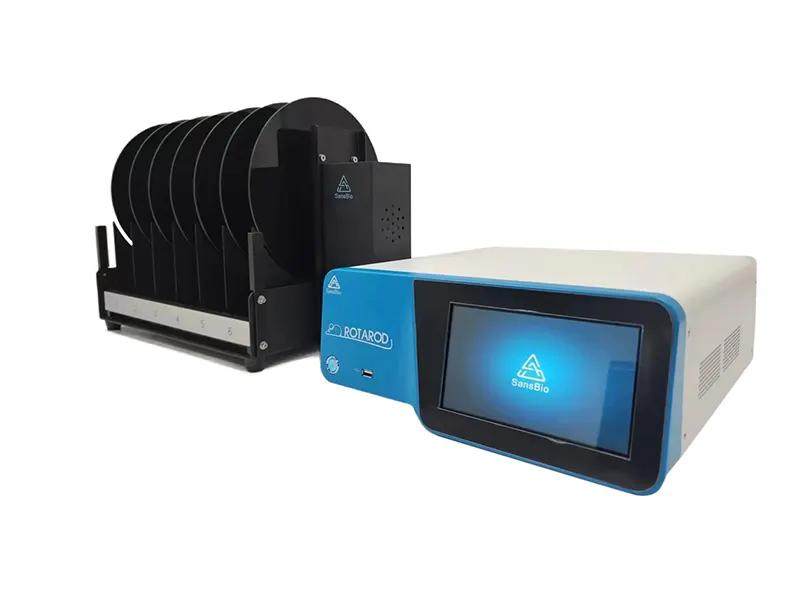
Motor coordination studies can use the RotaRod in different ways depending on what the experiment needs to measure. A constant-speed protocol applies a stable rotational demand, while an accelerating protocol progressively increases the challenge.
Understanding that difference helps researchers choose a test design that produces interpretable motor performance data without adding unnecessary variation.
Clarify What the Test Should Measure
Start with the primary outcome. If the study focuses on how long an animal can remain on a rod under a consistent workload, constant speed may offer a straightforward setup. If the goal is to observe when coordination breaks down as the motor challenge rises, acceleration provides a different testing condition.
Neither approach is automatically appropriate for every study. The choice should reflect the research model, expected motor deficit, drug intervention, training protocol, and analysis plan.
Use Constant Speed for a Stable Challenge
A constant-speed RotaRod keeps rotational demand at a selected level during the test. This can be useful when researchers want to compare performance under the same motor demand across groups or sessions. Outcomes such as latency to fall can then be examined alongside the fixed rotational condition.
Constant-speed testing can also fit repeated assessments where maintaining the same challenge is important. Researchers should establish the selected speed, trial duration, number of trials, rest intervals, and failure criteria in advance and apply them consistently throughout the relevant groups.
Use Acceleration for Progressive Motor Demand
An accelerating protocol changes the challenge during the trial, requiring the animal to continuously adapt its movement as rotational speed rises. This design can be useful for studies examining motor coordination, balance, motor learning, fatigue, or treatment-related changes in performance.
The official RotaRod supports constant and uniform acceleration modes, as well as reverse-ramp, mixed acceleration/deceleration, and rocking modes. Its specification lists a speed range of 0.05–100 RPM with 0.1 RPM steps, giving researchers flexibility when developing progressive protocols.
Interpret Results from a Rotarod Performance Test
In a rotarod performance test, falling time is closely connected to the experimental conditions. Under constant speed, latency to fall can describe performance at a defined rotational demand. Under acceleration, the same endpoint is associated with both time and the changing speed experienced before the fall.
For that reason, researchers should record the protocol settings together with the outcome. The system records latency, initial speed, final speed, acceleration speed, drop speed, revolution, ramp, and rotating mode, allowing the test conditions and results to be reviewed together.
Researchers can also consider whether the protocol is intended for baseline characterization, treatment comparison, or longitudinal assessment. Keeping the test purpose consistent helps make changes in latency or final speed easier to interpret across sessions and experimental groups.
Match the Test to the Animal Model
The physical configuration also matters when comparing protocols. The RotaRod can be configured for mice or rats by changing the rod frame. The official specification lists six lanes for mice with a 30 mm rod diameter and 20 mm fall height, while the rat configuration has four lanes, a 60 mm rod diameter, and a 30 mm fall height.
The same control unit can be used for six mice or four rats, supporting laboratories that conduct both types of studies. Researchers should still keep species, lane configuration, rod dimensions, and protocol settings consistent within each comparison.
Standardize Training and Test Conditions
Acclimation and pre-training can influence how animals respond during formal testing. The company’s RotaRod guidance recommends habituating animals to the testing environment and training them on the apparatus before testing. Its published procedure describes repeated training sessions before the formal test.
For reproducibility, document the training schedule, starting speed, progression, number of trials, rest intervals, and criteria for completing a trial. Cleaning the rod between animals and keeping handling procedures consistent can also support standardized testing conditions.
Select a RotaRod That Fits the Protocol
The value of a rotarod performance test depends on how closely the testing mode matches the scientific question. Constant-speed and accelerating protocols offer different ways to challenge motor coordination, so the appropriate choice should come from the study design rather than a preference for one mode.
BioMed Easy Technologies has an R&D and manufacturing facility and develops laboratory animal and neuroscience research equipment. It’s product categories including Motor Coordination, Pain, Learning & Memory, Anxiety, Fear & Emotion, Reward & Addiction, Video Tracking, Physiology & Neurosurgery, and Animal Care.
Multiple rotation modes, eight protocol configurations, precision infrared detection, USB data export, and storage for more than 2,000 datasets give the RotaRod the flexibility to cover different motor coordination protocols.
BioMed Easy is available for technical support, training, and after-sales service when a laboratory plans a mouse or rat motor coordination study.