

Water treatment projects often face the same basic question: how much separation does the application require? Reverse osmosis and nanofiltration both use pressure-driven membranes, but they are designed for different treatment objectives. Understanding the distinction can help municipalities, industrial facilities, and engineering companies select a process that fits the feed water, target quality, and operating conditions.
How Reverse Osmosis and Nanofiltration Differ
Reverse osmosis and nanofiltration are both membrane separation technologies, but their separation characteristics are not identical. Reverse osmosis provides a tighter barrier and is widely used when the treatment process needs substantial reduction of dissolved salts and other small contaminants. Nanofiltration generally allows more water and some smaller dissolved substances to pass while still providing meaningful removal of selected salts, organic compounds, and hardness.
This difference makes process selection an important design decision. A project requiring highly desalinated water may lean toward RO, while another application may benefit from the balance between separation performance and operating economy offered by NF. The right choice depends on the source-water composition and the quality required after treatment.
When Reverse Osmosis Makes More Sense
Reverse osmosis is commonly considered when dissolved solids and salinity are major concerns. Because the membrane provides a tighter separation, RO can be used for applications requiring a higher degree of desalination. Industrial water treatment may use RO for pure-water preparation, boiler feed-water production, desalination, and other processes where dissolved salts need to be controlled.
The trade-off is that RO systems generally require higher operating pressure than nanofiltration. This means engineers need to look beyond rejection performance and consider pumps, energy consumption, pretreatment, recovery, and maintenance as part of the overall system design.
For a company evaluating membrane options, reverse osmosis nanofiltration should therefore not be viewed as one interchangeable category. RO and NF can address different points on the treatment spectrum, and selecting between them starts with defining the actual water-quality objective.
Where Nanofiltration Can Be a Better Fit
Nanofiltration can be useful when a project needs selective separation without the same degree of desalination associated with conventional RO. Runmo’s NF Seriesprovides high permeate water production and desalination performance while also providing rejection of pesticides, microorganisms, and natural organic substances under appropriate treatment conditions. The manufacturer lists applications including pure water, boiler recharge water, food processing, and pharmaceutical manufacturing.
Another consideration is operating economy. Runmo states that its NF products are designed to operate at relatively low pressure, which can support lower system and operating requirements. In a project where complete desalination is unnecessary, this characteristic can make nanofiltration worth evaluating alongside RO.
The decision should still be based on actual feed-water conditions. Organic content, hardness, TDS, pH, temperature, turbidity, and the desired permeate quality can all affect whether NF is appropriate. A membrane process that looks attractive on paper may not be suitable if the system conditions fall outside the recommended operating range.
Product Options for Different Water Treatment Goals
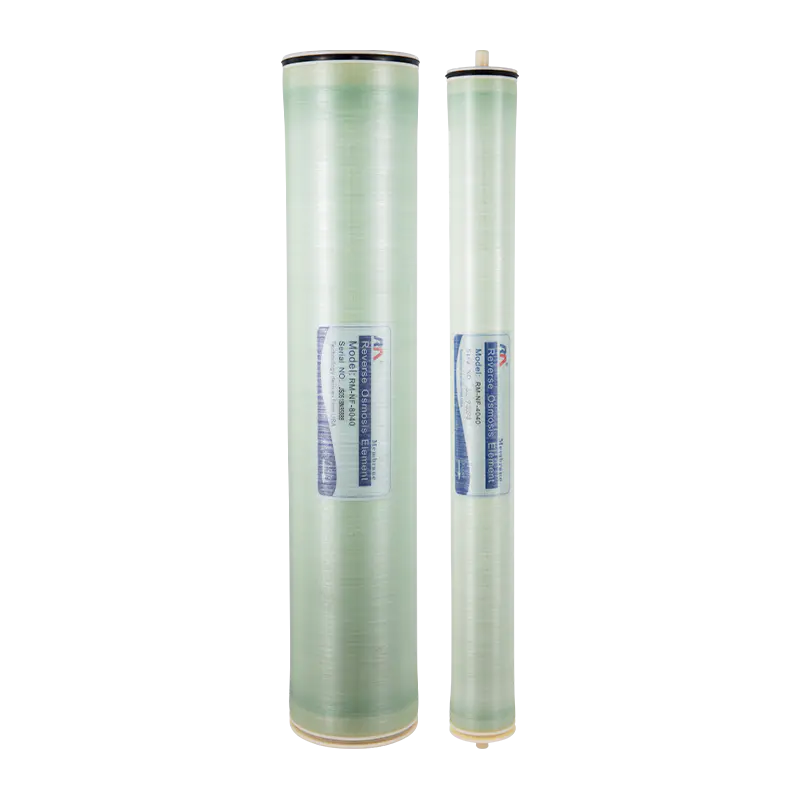
Runmo’s NF membrane range provides a practical example of how nanofiltration can be configured for different project capacities. The product page lists the RM-NF-4040 and RM-NF-8040 models. The 4040 model has a membrane area of 7.9 m² and an average permeate production of 7.9 m³/day under the manufacturer’s stated test conditions, while the 8040 model provides 37 m² of membrane area and an average permeate production of 33.9 m³/day. Both models list a stable rejection range of 55–75% under those test conditions.
These figures are useful for comparison, but they should not be treated as universal field performance. Runmo’s published testing uses 70 psi pressure, 25°C, a solution containing 2,000 ppm NaCl and 2,000 ppm MgSO4, pH 8, and 15% recovery for a single element. Actual water yield and rejection can vary with feed-water quality, pressure, temperature, recovery, and system configuration.
The listed operating limits also illustrate the importance of technical matching. For example, the NF Series has a maximum working pressure of 600 psi, maximum feed-water temperature of 45°C, maximum feed-water TDS of 2,000 ppm, and a continuous operating pH range of 3–10. Feed-water COD, BOD, TOC, turbidity, SDI, and hardness are also subject to specified limits.
How to Select the Right Process
Choosing between RO and NF should begin with the project objective rather than the membrane label. Start by identifying the contaminants that need to be reduced and establishing the target quality of the treated water. Then compare the feed-water analysis with the recommended operating range of the membrane.
Pretreatment also deserves careful attention. Suspended solids, organic matter, microorganisms, and other contaminants can affect membrane performance. A well-designed pretreatment stage helps protect the membrane and provides more stable operating conditions. For engineering companies and smaller water-treatment businesses, membrane specifications should therefore be evaluated together with the overall system requirements.
Cost and delivery are also practical purchasing considerations. Product price matters, but so do expected operating requirements, maintenance, replacement planning, technical support, and lead time. These factors can become especially important when membranes are being purchased for multiple projects or when an existing system needs a compatible replacement.
Making a More Informed Membrane Choice
RO and NF should not be treated as competing technologies where one is automatically better. Each serves a different treatment purpose. RO is generally the stronger option when deeper desalination is required, while NF can be attractive when selective removal and a different balance of separation and operating pressure are more appropriate.
Runmo offers multiple membrane technologies across its product portfolio, including nanofiltration, reverse osmosis, ultrafiltration, seawater, and brackish-water solutions. That broader range gives buyers more room to match membrane selection with actual feedwater and project requirements. For a new treatment system or membrane replacement project, starting with water analysis and the required treatment result can help identify a practical membrane option for the application.