

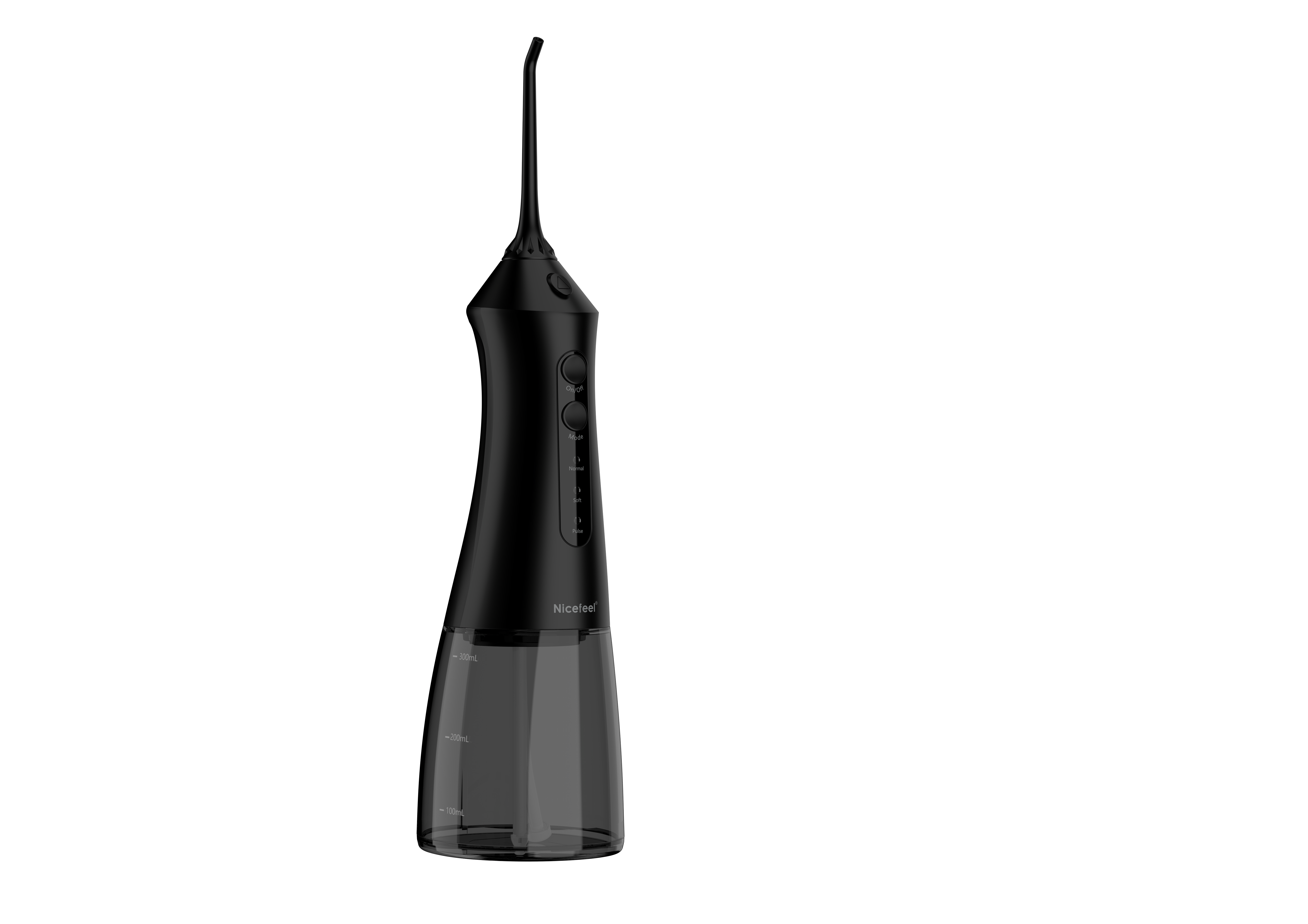
A jet washer for teeth uses a controlled stream of water to clean around areas that can be difficult to reach with a toothbrush. Unlike string floss, a water jet relies on pressure and pulsed delivery. For buyers evaluating oral-care products, understanding how stream control, pressure, tank capacity, and handling work together is more useful than focusing on pressure alone.
The American Dental Association recognizes water flossers as powered interdental cleaners. A 2025 systematic review found that dental water jets may provide some benefits for gingival health, although results for plaque removal varied by comparison and patient group. They should therefore be presented as an interdental-cleaning option rather than a replacement for every oral-care method.
How Does a Focused Water Stream Work?
A water jet directs water through a small nozzle opening, creating a focused stream that can be guided between teeth and along the gumline. Pulsed delivery adds repeated impacts rather than relying only on a continuous flow.
Why Pressure Range Matters
Pressure is one of the clearest specifications to review when comparing a jet washer for teeth. Higher maximum pressure does not automatically mean a better user experience. A useful device should provide a range that lets users select an appropriate intensity.
The FC5570 lists an impact specification of 2.5–11 g, corresponding to 21–115 PSI, with three working modes: high, low, and pulse. Its pulse number is 1250±20% RPM. This gives buyers measurable information about water delivery instead of reducing performance to one maximum-pressure figure.
Look at Water Capacity and Flow Design
Tank capacity affects how long users can operate the appliance before refilling. A larger reservoir can reduce interruptions, while a compact form may be easier to handle or store. Buyers should assess these factors together because capacity is closely connected to overall product structure.
The FC5570 uses a 300 mL open water tank. Its product page describes a concise open-tank design. For a waterproof water flosser, water access should be convenient while the surrounding structure remains suitable for the intended wet environment.
Consider Operating Modes
Different modes can make water delivery more adaptable. A low setting may provide a gentler starting point, while high and pulse settings offer alternative operating patterns. The benefit is not simply having more buttons; it is giving users understandable control.
The FC5570 uses one-key switching between high, low, and pulse modes. This straightforward interface can support simple operation for everyday users and give brands clearly defined functions for product communication.
Waterproofing Supports Everyday Use
Because oral irrigators are commonly operated around sinks and water, waterproofing is an important consideration. The FC5570 carries an IPX7 waterproof rating. The rating should be communicated according to the manufacturer’s stated specification rather than extended into unsupported claims about every type of water exposure.
A waterproof water flosser also needs routine maintenance. Users should follow cleaning, drying, charging, and storage instructions. Water resistance protects the designed structure, but it does not remove the need for regular care of the tank and nozzle.
Handling and Noise Also Matter
Technical output is only one part of usability. The FC5570 measures 84.85 × 72 × 219.2 mm and has a net weight of approximately 241 g. Its curved design is intended to provide a comfortable grip, which can make nozzle positioning easier during cleaning.
The model lists a noise standard of no more than 72 dB. Noise should be considered alongside pressure, motor design, and operating mode. Size, weight, grip design, and acoustic performance all contribute to everyday practicality.
What Flycat Brings to This Category
For brands developing a waterproof water flosser, specification flexibility can matter when selecting a platform. Flycat’s FC5570 combines a 300 mL tank, three operating modes, 21–115 PSI pressure, a 1200 mAh battery, IPX7 protection, and a 241 g handheld format. Their product page positions the model as a handheld water flosser.
Flycat operates an OEM/ODM manufacturing platform for global oral-care brands and distributors. They state that their facility covers more than 20,000 square meters, includes over 600 employees and more than 40 R&D engineers, and operates 30 production lines with daily capacity of up to 30,000 units. Their services cover product development through mass production and delivery.
Reviewing the FC5570 for Product Planning
When assessing a jet washer for teeth for a commercial product line, buyers can create a specification matrix covering pressure, pulse rate, modes, tank capacity, battery, charging time, dimensions, weight, noise, and waterproofing. This helps compare performance, portability, user experience, and market positioning.
The FC5570’s published specifications provide a defined starting point: 300 mL tank capacity, 1250±20% RPM pulse number, 21–115 PSI impact range, 1200 mAh battery, charging time of no more than four hours, and IPX7 waterproofing. These figures can support precise technical discussions during sourcing and customization.
Final Thoughts
A jet washer for teeth works through controlled water delivery, but its practical value comes from the complete system behind that stream. Pressure range, pulse behavior, tank capacity, operating modes, handling, noise, battery, and waterproofing all affect how a product can be positioned and used.
For businesses exploring this category, Flycat offers the FC5570 as a defined handheld platform and supports OEM/ODM cooperation. They can work with brands and distributors on product development and manufacturing requirements, allowing technical specifications to be considered alongside customization and production needs.