

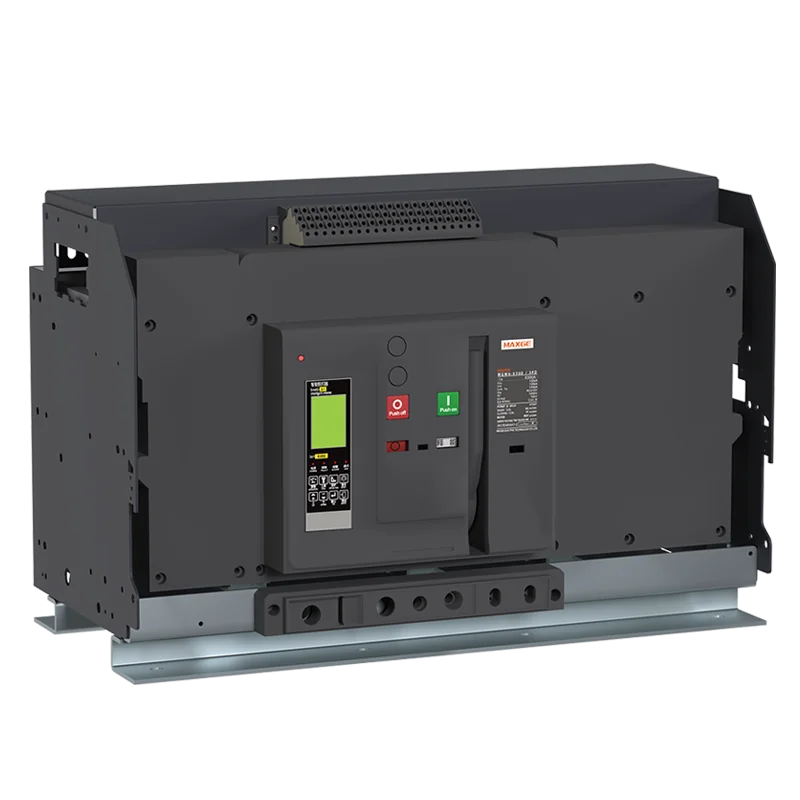
Medium-voltage networks require reliable switching and protection equipment to manage fault currents, maintenance operations, and changing load conditions. Among the available technologies, vacuum circuit breakers are widely considered for applications where dependable interruption, compact equipment design, and reduced maintenance are important.
For engineers, contractors, system integrators, and equipment purchasers, selecting the right breaker involves more than comparing rated current or breaking capacity. The operating environment, network configuration, switching frequency, protection requirements, and maintenance strategy all influence the final choice. Understanding where vacuum circuit breakers fit within modern electrical control products can make equipment selection more practical and cost-effective.
How Vacuum Circuit Breakers Work
A vacuum circuit breaker uses a vacuum interrupter as the medium for extinguishing the electrical arc created when contacts separate. Because there is no conventional gas or oil surrounding the contacts, the interrupter can provide effective insulation and arc interruption within a relatively compact structure.
When a fault occurs, the protection system sends a trip signal to the operating mechanism. The contacts separate, an arc forms briefly, and the vacuum environment helps interrupt the current. After interruption, the dielectric strength between the contacts recovers rapidly, helping prevent the arc from restriking.
This operating principle makes vacuum interruption suitable for many medium-voltage switching applications, particularly where frequent operation and consistent electrical performance are required.
Where Medium-Voltage Vacuum Circuit Breakers Are Used
Vacuum circuit breakers are commonly associated with medium-voltage distribution networks, substations, industrial facilities, commercial infrastructure, and motor control applications. Their ability to interrupt fault currents and perform repeated switching makes them suitable for systems where both protection and operational flexibility are important.
In industrial facilities, for example, breakers may be used to protect transformers, motors, feeders, and other major loads. In distribution networks, they can help isolate faulted sections while allowing unaffected parts of the system to remain in service.
The actual application should always be determined according to the network’s voltage level, short-circuit conditions, load characteristics, protection coordination requirements, and applicable standards.
Key Benefits to Consider
One important advantage of vacuum interruption is its relatively low maintenance requirement. Since the interruption process takes place inside a sealed vacuum interrupter, there is no need to manage insulating oil, and the interrupter itself is designed for long-term operation.
Vacuum circuit breakers can also provide fast and reliable fault interruption. Their compact interrupter construction can support equipment designs where available switchgear space is limited. For facilities where switching operations occur regularly, the technology can offer practical operational advantages.
Another consideration is environmental management. Compared with oil-based interruption technologies, vacuum interrupters do not require insulating oil as the arc-extinguishing medium. This can simplify certain equipment arrangements and maintenance procedures.
However, these advantages do not mean that every medium-voltage application should automatically use a vacuum circuit breaker. System requirements remain the primary consideration.
Understanding the Limits Before Selection
Proper selection requires attention to several technical factors. Rated voltage and rated current must match the electrical network, while short-circuit withstand and breaking capabilities need to correspond with the prospective fault conditions.
Protection coordination is equally important. A circuit breaker should operate in coordination with upstream and downstream protective devices so that faults can be isolated without unnecessary interruption to other circuits.
Switching characteristics also deserve consideration. Certain loads, including motors and transformers, can produce transient electrical phenomena during switching. The breaker, operating mechanism, and overall switchgear configuration should therefore be evaluated as a complete system rather than as an isolated component.
These considerations are particularly important when comparing circuit breaker manufacturers or evaluating different electrical switchgear manufacturers. Technical documentation, testing requirements, certification, service support, and compatibility with the intended switchgear should all form part of the evaluation.
How It Fits Into a Broader Protection System
A medium-voltage breaker is only one element within an electrical protection architecture. Depending on the application, the complete system may include protection relays, current transformers, voltage transformers, disconnectors, grounding equipment, control components, and monitoring systems.
For facilities using multiple types of industrial electrical products, consistency between protection devices can also simplify engineering and maintenance. A well-planned system should provide appropriate protection while allowing operators to identify faults, isolate equipment, and restore power efficiently.
This broader approach is useful when evaluating circuit breaker solutions for industrial plants, infrastructure projects, power distribution systems, and other applications where equipment continuity matters.
Choosing the Right Electrical Control Products
The best solution depends on the actual electrical parameters and operating conditions rather than on a single product specification. Engineers should review rated voltage, current, fault level, switching duty, installation conditions, protection coordination, applicable standards, and long-term maintenance requirements before making a decision.
MAXGE develops low-voltage electrical solutions for residential, commercial, industrial, and new-energy applications. Its solutions cover key needs such as terminal circuit protection, power distribution, overload and residual current protection, intelligent electrical management, and industrial control, with applications extending to PV, energy storage, and EV charging systems. By combining different protection and control devices according to system requirements, MAXGE supports electrical projects from individual circuits to broader distribution and energy management applications.
For projects requiring coordinated protection across different parts of a distribution system, evaluating the complete product range can help create a more consistent equipment strategy.
Making a Practical Decision for Your Network
Vacuum circuit breakers can be a suitable option for many medium-voltage applications because of their vacuum-based interruption principle, compact construction, and maintenance characteristics. At the same time, their suitability depends on the electrical network, switching duty, protection scheme, equipment configuration, and applicable installation requirements.
Choosing electrical control products should therefore begin with the application’s technical requirements and continue through product verification, system coordination, installation, and maintenance planning. MAXGE combines smart manufacturing with automated production across its Deqing and Wuhu manufacturing bases, with more than 90% automation, while its R&D team and testing capabilities support ongoing product development. Its broader electrical portfolio covers low-voltage protection and control as well as applications in PV, energy storage, and EV charging.
With international certifications and CNAS-related laboratory capabilities, MAXGE supports electrical product development and market requirements across different regions. Its MAXGE, EMA, and GEBLER brands serve customers in more than 60 countries through a network of over 80 distribution partners. If you are evaluating circuit breaker solutions or need information about suitable electrical products for a specific project, you can contact MAXGE through its official contact page for product and application information.