

In commercial and industrial projects, lighting selection involves more than lumen output, energy efficiency, and installation cost. The environment in which a luminaire operates can have a direct influence on its suitability and service requirements.
Dust, moisture, cleaning processes, and airborne particles are common considerations in warehouses, workshops, production areas, parking facilities, and other working environments. This is where the IP rating becomes an important specification when evaluating lighting equipment.
Buyers planning an industrial lighting project, understanding what an IP code actually indicates can make product comparison more practical. An IP rating does not describe the overall quality of a luminaire.
Instead, it classifies the protection provided by an enclosure against the intrusion of solid objects and water under defined test conditions.
What Does an IP Rating Mean?
IP stands for Ingress Protection. The classification is defined by IEC 60529 and uses two numerals. The first numeral concerns protection against solid foreign objects, while the second addresses protection against water. The first digit ranges from 0 to 6, and the second ranges from 0 to 9 under the standard’s classification system.
For example, in an IP65 rating, the “6” indicates a dust-tight enclosure classification, while the “5” indicates protection against water jets. This does not mean that every IP65 luminaire can be installed in any wet environment. The rating relates to specific test conditions, so project teams still need to consider installation position, exposure, cleaning methods, temperature, and other site conditions.
This distinction is particularly relevant when comparing luminaires marketed for industrial or commercial applications. Terms such as “weather-resistant” or “waterproof” can be broad marketing descriptions, whereas an IP code provides a standardized reference point for enclosure protection.
Why IP Ratings Matter When Selecting an LED Batten
A linear led batten may be used across very different environments. A dry office corridor has different environmental demands from a manufacturing floor, warehouse, underground parking area, or retail loading zone. Selecting a luminaire simply because it has a higher IP number can therefore be misleading.
The first step for a B2B buyer is to identify the environmental conditions at the installation site. Areas with considerable dust or fine particles may place greater importance on the first IP digit. Locations exposed to splashing, water jets, condensation, or regular cleaning may require closer attention to the second digit.
It is also useful to distinguish IP protection from other performance specifications. IP ratings do not describe impact resistance, optical performance, color rendering, glare, energy efficiency, or electrical efficiency.
These characteristics need to be evaluated separately in the context of a commercial lighting project. A luminaire with an appropriate IP classification may still be unsuitable if its optical distribution or mounting method does not meet the project’s lighting requirements.
How Buyers Should Read the Two Digits
The first digit provides a useful indication of protection from solids. IP5X represents dust-protected performance under the relevant test conditions, while IP6X represents a dust-tight classification.
The second digit describes resistance to different forms of water exposure. IPX4 corresponds to protection against splashing water, IPX5 to water jets, IPX6 to powerful water jets, and higher classifications address immersion conditions.
For project procurement, the important point is that a higher number is not automatically a better choice for every application. A specification should match the actual environmental exposure. Over-specifying protection can affect product selection and project cost, while under-specifying it can create operational concerns.
Applying IP Considerations to TRIECO’s Batten Luminaire
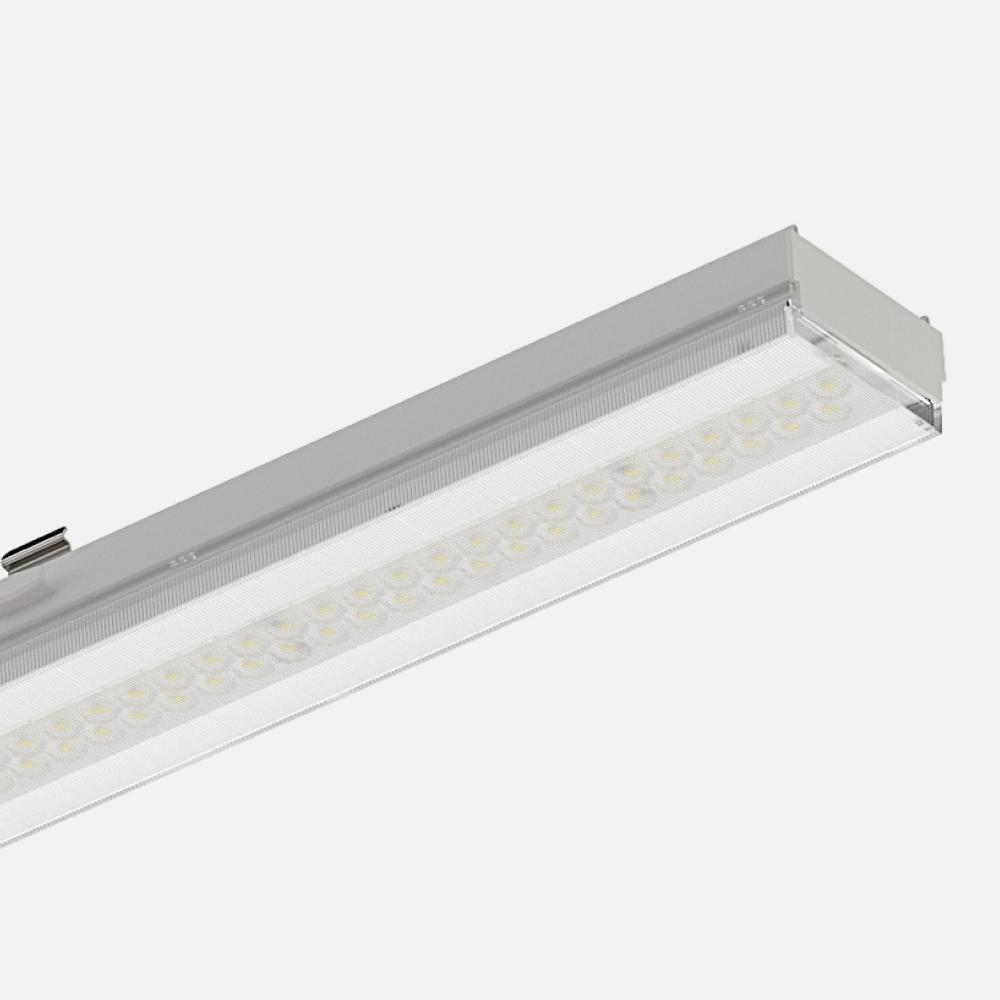
The company’s Batten Luminaire, intended for professional buyers, is positioned for several practical environments, including retail, industrial, and underground parking spaces.
Its design supports either suspended or surface-mounted installation, while the push-to-open cover is intended to simplify maintenance access. The product is available in three fixture widths: 55 mm with a PC diffuser cover, 136 mm with a PC diffuser cover, and 157 mm with a prismatic PC cover.
The luminaire also provides several optical and performance options. TRIECO specifies beam angles of 110°, 120°, and 125°, with available color temperatures of 3000K, 4000K, 5000K, and 5700K.
The published product information states luminous efficacy of up to 150 lm/W and luminous flux of up to 6000 lm, alongside CRI above 80. It also describes a low-glare optical design and a dual-optical approach using a soft-light filter or prismatic PC diffuser cover.
These specifications demonstrate why IP rating should be considered as one part of a broader procurement assessment. For an industrial facility, the buyer may need to review environmental protection together with mounting configuration, optical distribution, color temperature, glare control, maintenance access, and required illumination levels.
IP Rating Should Be Part of a Wider Project Assessment
For B2B lighting projects, the most useful approach is to treat IP classification as an environmental suitability indicator rather than a standalone measure of product quality. Facility managers, lighting distributors, contractors, and engineering teams can begin by documenting the conditions in each installation zone and then comparing those requirements with the manufacturer’s certified product specifications.
This approach can also help when different areas within one facility have different requirements. A dry office section, production area, storage zone, and underground parking facility may not need identical luminaires. Matching the product to the environment can make the specification more rational and help project teams avoid relying on generic assumptions.
TRIECO’s portfolio includes industrial, retail, and office lighting solutions, with manufacturing and project-support capabilities structured around full project delivery rather than individual fixture sales.
For buyers assessing LED battens, the IP code is therefore a useful starting point, but not the final decision. Understanding the two digits, identifying real site conditions, and then reviewing the complete product specification can lead to a more appropriate lighting specification and a more informed purchasing decision.