

Agrochemical manufacturers must maintain consistent formulation quality while controlling production costs, minimizing downtime, and meeting increasingly demanding customer requirements. Whether producing pesticide suspension concentrates, emulsifiable concentrates, or other liquid formulations, the mixing process can directly influence dispersion quality, storage stability, and batch-to-batch consistency. When existing equipment struggles to meet these demands, upgrading the homogenization process may be worth considering. Recognizing the warning signs early helps production managers identify process limitations before they affect delivery schedules and product quality.
1.Formulations Show Inconsistent Particle Distribution
Uneven particle distribution is a common warning sign in agrochemical production. Poorly dispersed active ingredients, suspended solids, or additives can create visible agglomerates, sedimentation, and inconsistent product appearance. These problems may indicate that the current mixing system cannot provide sufficient shear or circulation for the formulation.
A high shear mixer can help break down agglomerates and distribute solid particles more evenly throughout a liquid phase. However, results depend on particle properties, formulation chemistry, equipment configuration, and operating conditions. Manufacturers should compare particle-size measurements and dispersion results across batches before deciding whether equipment replacement is necessary.
2.Emulsions Separate or Lose Stability During Storage
Agrochemical formulations often combine ingredients with different physical properties. Emulsifiable products, for example, require effective dispersion of one liquid phase within another. If droplets remain too large or the distribution is inconsistent, the formulation may develop creaming, separation, or other stability problems during storage.
Upgraded homogenizer equipment such as FLUKO’s may improve droplet-size reduction and distribution when inadequate emulsification is the underlying cause. Nevertheless, mixing alone cannot resolve every stability issue. Surfactant selection, ingredient compatibility, temperature, and formulation design also matter. Reviewing stability-test results alongside mixing parameters helps determine whether the existing equipment is limiting performance.
3.Production Cycles Take Longer Than Planned
When a formulation requires repeated mixing, extended processing, or manual intervention to reach its target quality, production capacity can suffer. Older equipment may struggle with changing viscosities, difficult-to-wet powders, or higher batch volumes. The result can be longer cycle times, inconsistent throughput, and growing pressure on downstream filling operations.
A properly selected high shear mixer can improve dispersion efficiency by generating intense localized shear and promoting material circulation. Inline systems may also suit continuous processing, while batch units can fit existing vessels and established workflows. Before upgrading, manufacturers should measure mixing time, batch volume, energy consumption, and output quality to establish a realistic performance baseline.
4.Quality Control Rejects and Rework Are Increasing
Frequent out-of-specification results can signal that a mixing process is becoming difficult to control. Variations in particle size, viscosity, suspensibility, or emulsion stability may lead to additional testing, reprocessing, and delayed batch release. These issues are particularly important when products must maintain consistent physical properties throughout their intended storage life.
A homogenization upgrade may help reduce process variation when equipment performance is a contributing factor. However, the investigation should also cover raw-material variability, ingredient dosing, temperature control, and formulation design. Reviewing quality-control records alongside operating parameters can reveal whether improved shear performance, better circulation, or more suitable process integration would address the recurring problems.
5.Existing Equipment Cannot Support New Production Requirements
An agrochemical plant may expand its product portfolio, introduce more demanding formulations, or increase production volumes without replacing its original mixing system. Equipment that performed adequately for established products may no longer meet the requirements of newer formulations, especially when viscosity, solid content, or emulsification demands change.
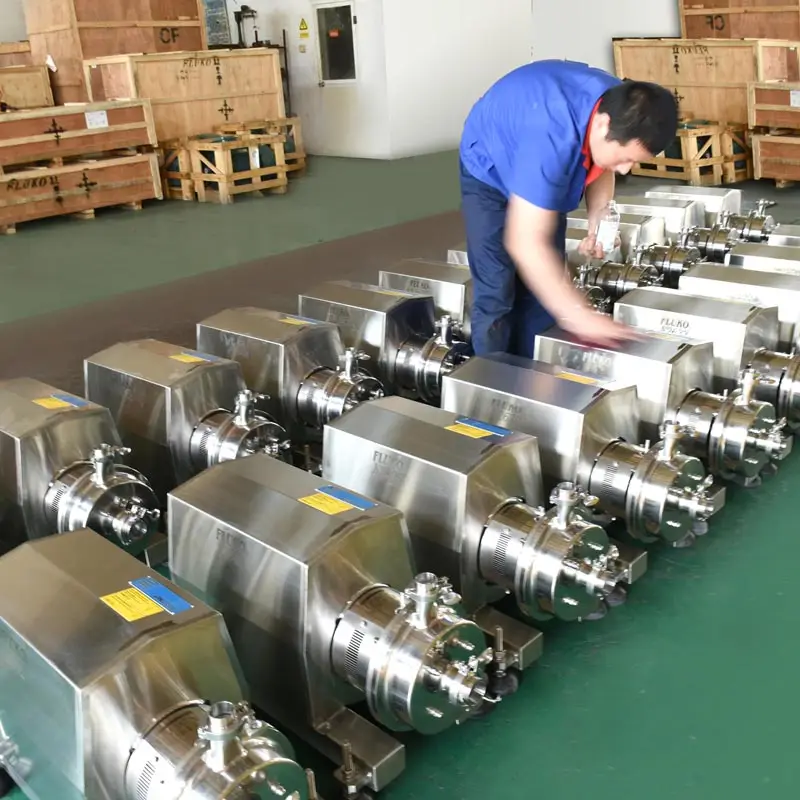
Modern homogenizer equipment can offer different configurations for specific processing needs. FLUKO, a manufacturer of high-shear mixing and homogenizing systems, provides batch and inline solutions for dispersion, emulsification, and mixing. Its industrial range includes top-loading and bottom-loading homogenizers, as well as inline models. The appropriate choice depends on the formulation, vessel arrangement, throughput target, and maintenance requirements rather than equipment capacity alone.
An upgrade assessment should therefore consider both immediate bottlenecks and anticipated production changes. A system that supports current recipes while accommodating planned capacity increases may offer better long-term value than selecting equipment solely on its purchase price.
Turn Mixing Problems Into an Upgrade Plan
The five signs provide a practical starting point for evaluating whether an agrochemical production line needs improved homogenization. Persistent dispersion defects, unstable emulsions, lengthy processing cycles, repeated quality failures, and changing production requirements all warrant closer investigation. Equipment replacement should follow process data rather than assumptions, with particular attention to formulation performance and measurable production losses.
Working with an experienced high shear mixer manufacturer can help production teams compare batch and inline configurations, assess process compatibility, and identify suitable equipment for existing formulations. FLUKO emphasizes customer-centric innovation and long-term cooperation, aligning its approach with manufacturers seeking application-specific mixing solutions.
Ultimately, the right homogenizer equipment upgrade should address a documented process limitation, support consistent product quality, and fit the plant’s operational goals. Pilot trials, performance comparisons, and a clear evaluation of lifecycle costs can help decision-makers build a stronger business case before committing to a new system.