

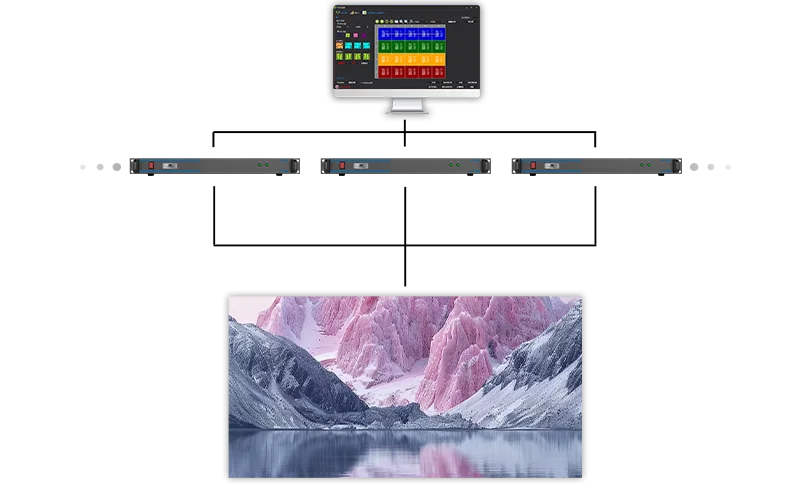
An LED display system depends on multiple control components working together, and the sending card is one of the most important parts of the signal transmission process. It connects video sources with receiving cards inside LED cabinets, ensuring that content is delivered accurately to every pixel.
Choosing the right LED display sending card requires careful consideration of resolution, pixel load capacity, and operational stability. A suitable card can improve image quality, simplify installation, and support reliable performance for applications such as stage events, commercial displays, XR studios, and large LED video walls.
Understanding the Role of an LED Display Sending Card
An LED display sending card converts video signals from a computer, controller, or media server into data that LED receiving cards can process. Without this conversion, LED modules cannot display standard video sources directly.
In a professional LED control system, the sending card manages signal distribution, resolution configuration, and communication between the input source and display cabinets. It determines how much content can be processed and how efficiently data moves through the entire system.
Kystar develops sending card solutions designed for different LED display requirements, including commercial screens, large venues, and high-performance visual environments. Its ES Series provides different load capacities and output configurations to help integrators match hardware with project needs.
Selecting the Right Resolution Capacity
Resolution is the first factor to evaluate when choosing an LED display sending card. The total pixel amount of an LED screen directly affects the processing capability required from the card.
A small indoor display may only need a basic sending card, while a large outdoor screen, stage backdrop, or XR production wall requires higher processing capacity. If the card cannot support the screen resolution, users may experience incomplete images, limited display areas, or reduced visual performance.
Engineers should calculate the total horizontal and vertical pixels of the LED screen before selecting a model. The sending card should provide enough capacity for current requirements while leaving room for future expansion.
For example, Kystar ES Series products offer different load options. The ES6 supports up to 2.35 million pixels, while higher models such as ES10 and ES20 provide larger capacities for demanding projects. This allows users to select a solution based on screen size rather than over-investing in unnecessary processing power.
Matching Pixel Load Requirements
Pixel load capacity refers to the maximum number of pixels that a sending card can control. This specification directly impacts whether the hardware can operate a specific LED display smoothly.
When selecting an LED display sending card, users should consider not only the current screen size but also possible changes in content resolution. High-definition videos, complex graphics, and multi-layer visual effects require more processing resources than simple images.
Large entertainment projects often use wide LED screens with unusual shapes or multiple connected displays. In these situations, a sending card with higher load capacity provides better flexibility and reduces the need for additional devices.
Kystar ES Series sending cards are designed with scalable load options and multiple Gigabit Ethernet outputs. These features allow the systems to support projects ranging from digital signage to large venue displays.
Considering Signal Transmission and Reliability
Reliability is another essential factor when choosing an LED display sending card. In professional environments, signal interruption can cause serious problems, especially during live performances, broadcasts, or important commercial events.
A reliable sending card should provide stable signal transmission, efficient data management, and protection features that reduce the risk of display failure. Long-distance transmission requirements should also be considered because large venues may place control rooms far away from LED screens.
Modern solutions may include optical fiber transmission support for projects requiring longer distances and lower signal loss. Kystar’s ES Series includes 10G optical fiber interfaces on selected models, supporting high-speed transmission for large-scale applications.
Backup functions are also valuable for mission-critical projects. Ethernet port backup technology can maintain signal continuity if a primary connection experiences an issue, helping avoid unexpected black screens during operation.
Choosing Features for Different Applications
Different LED applications require different sending card features. A retail display may prioritize simple installation and cost efficiency, while a stage production requires fast response, high resolution, and advanced synchronization.
For XR virtual production, accurate signal processing and high-resolution input support are especially important because LED walls must provide realistic backgrounds for cameras and performers. For sports venues and live entertainment, stable transmission and large-scale screen management are key considerations.
Kystar provides sending card options with different interfaces and capabilities. Some models support high-resolution input, multiple Ethernet outputs, and advanced functions suitable for professional visual environments.
Evaluating Installation and Future Expansion
A good LED display sending card should not only solve current project requirements but also simplify future upgrades. Installation flexibility, mapping functions, and compatibility with different LED configurations can reduce maintenance time.
Complex LED structures, including curved screens and creative shapes, require flexible configuration methods. Features that simplify cabinet mapping and system setup can improve installation efficiency and reduce human errors during commissioning.
Before purchasing, project teams should review screen specifications, input requirements, transmission distance, and possible future expansion plans. A balanced choice can provide better long-term value and operational stability.
Conclusion
Choosing an LED display sending card requires more than checking basic specifications. Resolution capacity, pixel load, transmission reliability, and application requirements all influence the final decision.
A properly selected sending card ensures that LED systems deliver clear images, stable signals, and smooth operation. By matching the card’s capabilities with the display size and project environment, users can build more reliable and efficient visual solutions.
With professional products such as the ES Series, Kystar helps integrators and creators develop LED systems that meet the demands of modern commercial displays, entertainment projects, and advanced visual applications.