

Integrating additive manufacturing into commercial workflows requires looking well beyond initial machinery price tags. While entry-level desktop hardware can appear financially attractive on a purchasing ledger, evaluating a machine for business demands a thorough assessment of operational expenditure, scrap rates, power consumption, and facility integration costs. For small businesses, design studios, and prototyping labs, choosing the best budget enclosed 3D printer represents a strategic decision between upfront capital preservation and long-term production cost efficiency. Standard open-frame machines frequently struggle when producing functional components with engineering-grade polymers due to ambient thermal instability and localized draft exposure. Evaluating an enclosed platform involves analyzing how structural thermal isolation, integrated air filtration, and robust frame construction influence overall unit production costs and total return on investment over the complete operational lifecycle of the equipment.
Direct Capital Expenditure Versus Total Cost of Ownership
Financial evaluation must separate the initial equipment acquisition price from the comprehensive total cost of ownership. Unenclosed printers often carry lower acquisition costs, but their operational limitations quickly create hidden expenses in demanding commercial settings. Printing polymers such as Acrylonitrile Butadiene Styrene (ABS), Polycarbonate (PC), or Acrylonitrile Styrene Acrylate (ASA) in open ambient environments regularly leads to severe part warping, layer delamination, and print bed detachment. Every aborted print wastes expensive raw filament, consumes machine runtime, and increases operator labor spent on physical cleanup, surface re-preparation, and job resets. An enclosed chassis maintains a stable ambient microclimate that drastically reduces thermal shock and failure rates. Over several months of continuous production, the cumulative savings achieved through higher print success rates easily offset the higher initial expenditure of an enclosed build volume, turning the upfront capital cost into a reliable operational saving.
Chamber Thermal Dynamics and Material Yield Rates
The primary economic advantage of an enclosed printing volume lies in consistent thermal management throughout the build duration. High-performance thermoplastic polymers possess high coefficients of thermal expansion, causing them to shrink rapidly as they transition from a molten state to solid form. When cold ambient air currents drift across an active print surface, differential cooling stresses develop within the internal part geometry, causing structural deformation or bed lifting. An enclosed chamber traps residual heat emitted by the heated print bed and hotend, raising internal ambient temperatures to a stable operating range. This controlled microclimate maintains uniform layer contraction, ensuring tight dimensional accuracy and structural integrity across complex geometries. Higher first-pass yield rates directly protect profit margins by converting raw filament spools into billable finished components without unnecessary material scrap or costly reprint cycles.
Air Filtration, Workplace Safety, and Overhead Expenses
Operating additive manufacturing hardware in commercial offices, educational facilities, or shared working environments requires strict adherence to occupational health and safety standards. High-temperature printing processes release ultrafine particles and volatile organic compounds such as styrene into the surrounding environment. In open-frame setups, managing these airborne emissions requires installing external exhaust ducting, dedicated room ventilation, or standalone air purification units, all of which introduce additional facility overhead and recurring maintenance expenses. Enclosed machines equipped with integrated filtration systems mitigate airborne contaminants directly at the generation source. Utilizing multi-stage filtration with high-efficiency particulate air filters and activated carbon elements keeps workplace air clean without requiring expensive HVAC facility modifications, ensuring employee safety while keeping operational overhead predictable and controlled.
Operational Energy Efficiency and Batch Processing Capabilities
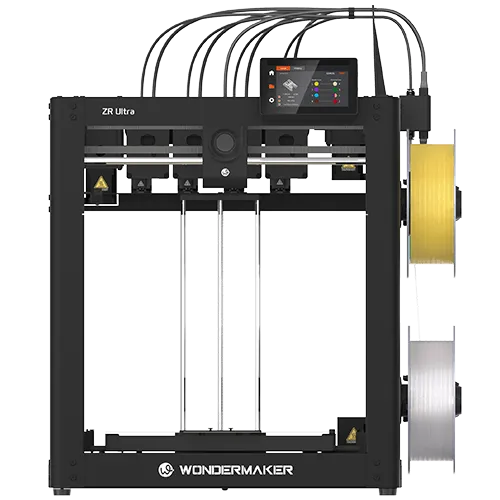
Power consumption represents a continuous operational expense that scales directly with overall machine utilization over time. Enclosed build volumes provide passive thermal insulation that minimizes radiant heat loss into the surrounding room environment. As a result, the heated print bed requires significantly less electrical energy to maintain elevated target temperatures over extended multi-day production runs compared to exposed heat beds operating in ambient room air. Furthermore, thermal stability enables predictable batch production where multiple components can be densely packed onto a single build surface without increasing the risk of edge warping on peripheral parts. Advanced multi-material enclosed platforms, such as the WonderMaker 3D ZR Ultra-S, combine insulated build volumes with active filtration, precise thermal control, and automated bed leveling across a generous work volume. The inclusion of multi-toolhead capabilities on platforms developed by WonderMaker 3D further allows businesses to execute complex multi-material prints or soluble support structures in a single automated process, reducing manual post-processing labor and shortening time-to-market.
Strategic Cost Optimization for Long-Term Production
Determining the true economic value of a desktop manufacturing platform requires a balanced perspective on machinery reliability, safety compliance, and overall throughput potential. While open-frame alternatives may lower initial entry barriers, their susceptibility to environmental drafts and high material failure rates increase overall unit production costs over extended operation. Selecting the best budget enclosed 3D printer allows businesses to achieve industrial-grade reliability, low scrap rates, and built-in environmental safety at an accessible price point. When evaluating overall equipment effectiveness, businesses should compare material waste, energy consumption, operator time, maintenance, and print success rates to determine whether an enclosed platform provides a better financial fit for their workflow.