

Accurate investigation after a traffic accident requires detailed evidence collection, reliable analysis, and clear reconstruction results. Traditional accident reconstruction methods often depend on specialized equipment, manual measurements, and professional expertise, which can increase the time required to complete complex cases. As digital technologies advance, vehicle accident reconstruction software is changing how investigators capture scenes, analyze evidence, and generate visual results.
By combining 3D modeling, artificial intelligence, and automated processing, modern reconstruction solutions make accident analysis faster and more accessible. Icecypress Technology, a spatial intelligence AI company specializing in 3D and AI technologies, provides the Rusa Rapid 3D Scene Reconstruction System. Designed as high-fidelity accident reconstruction software, Rusa simplifies the complete workflow from scene capture to final reconstruction output while maintaining centimeter-level accuracy.
The Challenges of Traditional Vehicle Accident Reconstruction
Vehicle accident reconstruction involves analyzing physical evidence to understand how an accident occurred. Investigators typically need to collect information about vehicle positions, road conditions, impact points, and environmental factors before creating a reconstruction model.
However, traditional workflows may involve several limitations. Professional surveying equipment can be expensive and difficult to operate, while manual data collection can take significant time, especially at complex accident scenes. Additionally, weather conditions, limited access areas, and time-sensitive investigations can affect the quality of collected information.
For organizations handling frequent accident investigations, improving efficiency without reducing accuracy has become a major priority. Digital reconstruction tools provide a practical solution by allowing teams to capture real-world scenes and transform them into detailed 3D environments.
A Three-Step Workflow Makes Accident Reconstruction More Efficient
Modern accident reconstruction software focuses on simplifying the entire reconstruction process. Instead of requiring multiple complicated stages, advanced platforms can integrate data collection, processing, and output into a streamlined workflow.
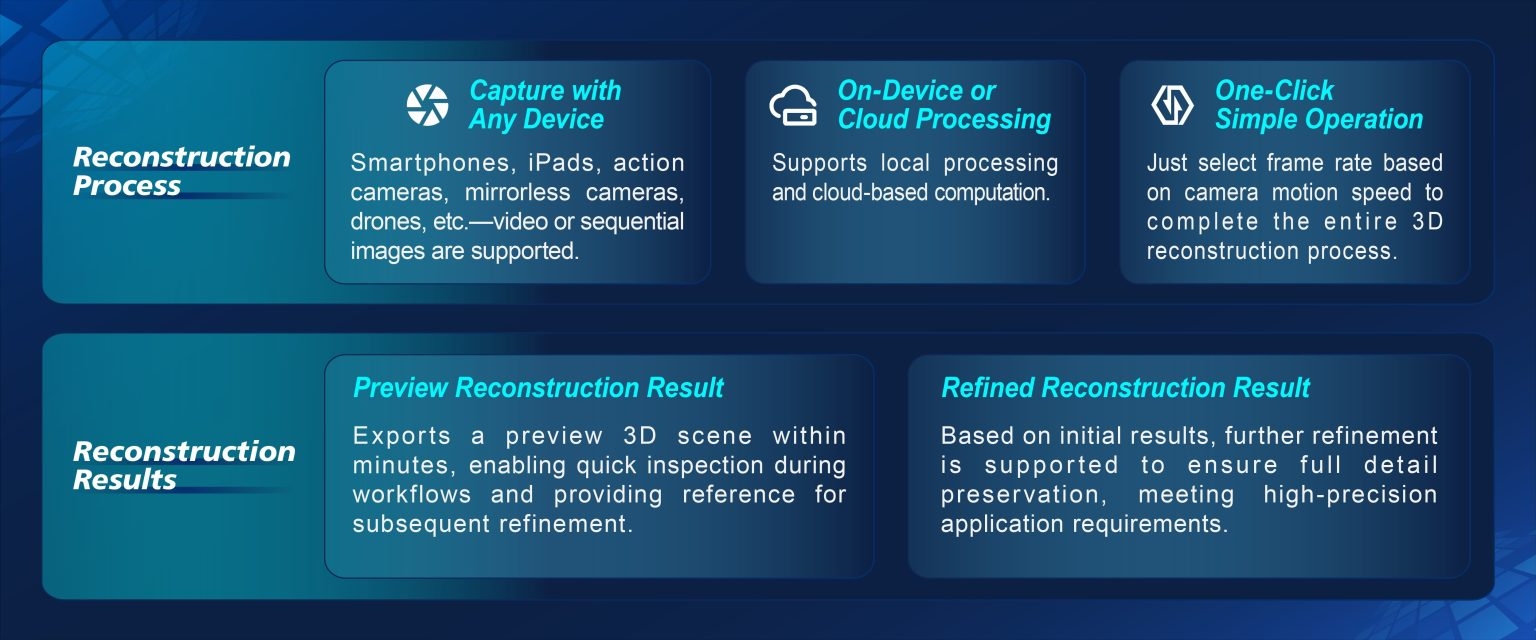
Icecypress Technology’s Rusa Rapid 3D Scene Reconstruction System uses a three-step process: capture, processing, and output. The system allows users to collect scene information, generate reconstruction models, and review results through an efficient closed-loop workflow.
This approach reduces unnecessary operations and makes 3D scene reconstruction accessible to more users. Frontline personnel can complete the process without requiring extensive professional training or advanced technical skills, improving response efficiency in real investigation environments.
Flexible Data Capture Without Professional Equipment
One of the biggest advantages of modern reconstruction technology is the ability to collect scene data using commonly available devices. Traditional approaches may require specialized cameras, scanners, or surveying tools, creating additional preparation requirements.
Rusa removes these barriers by supporting flexible capture methods. Users can record accident scenes without professional equipment, allowing more personnel to begin reconstruction tasks quickly. This flexibility makes the system suitable for different operational environments where fast evidence collection is important.
The platform also supports adaptive frame-rate extraction, which adjusts according to different shooting speeds and collection scenarios. Whether capturing a detailed accident site or a larger surrounding environment, the system can adapt to different field conditions.
Rapid 3D Processing Creates Immediate Scene Understanding
After data collection, efficient processing is essential for transforming footage into useful reconstruction results. Delayed processing can slow investigations and limit decision-making, especially when accident scenes need to be cleared quickly.
Rusa’s 3D scene reconstruction workflow enables minute-level preview generation, allowing users to confirm scene coverage before leaving the accident location. This capability helps ensure that important details have been captured and reduces the possibility of returning to the site for additional data collection.
By automating complex processing tasks, the system allows users to focus more on analysis rather than technical operations. The result is a faster transition from raw footage to a visual reconstruction environment.
High-Fidelity 3D Models Support Accurate Accident Analysis
The quality of a reconstruction model directly influences the accuracy of accident analysis. A detailed 3D representation allows investigators to examine spatial relationships, review evidence locations, and better understand possible accident scenarios.
Rusa provides centimeter-level accuracy for 3D scene reconstruction, helping create detailed digital representations of accident environments. These models can support analysis of vehicle positions, road layouts, and other important scene elements.
Compared with traditional documentation methods based mainly on photographs and notes, 3D reconstruction provides a more complete perspective. Investigators can revisit the digital scene, examine different viewpoints, and communicate findings more effectively.
All-Weather Operation Expands Reconstruction Applications
Accidents can occur under various environmental conditions, including rain, poor lighting, or challenging outdoor conditions. Reconstruction technologies need to maintain reliability beyond controlled environments.
Rusa is designed for all-weather efficient operation, supporting consistent scene capture across different conditions. This capability helps organizations maintain investigation efficiency regardless of when or where an accident occurs.
The system’s flexible adaptation also allows it to support various application scenarios. From traffic accident investigations to insurance assessments and safety analysis, digital reconstruction technology provides a scalable approach for organizations that require accurate scene documentation.
The Role of Digital Reconstruction in Future Investigations
As artificial intelligence and spatial intelligence technologies continue developing, accident investigation is becoming increasingly digital. Future reconstruction platforms will likely provide more automated analysis, faster processing, and stronger integration with other investigation systems.
Icecypress Technology combines 3D and AI technologies to create solutions that improve how physical environments are captured and understood. Through the Rusa Rapid 3D Scene Reconstruction System, the company helps organizations simplify reconstruction workflows while maintaining accuracy and usability.
By reducing dependence on specialized equipment and complex procedures, advanced reconstruction platforms allow more teams to benefit from digital scene analysis capabilities.
Advancing Accident Investigation Through Intelligent 3D Solutions
The evolution of vehicle accident reconstruction software is helping organizations improve investigation speed, accuracy, and accessibility. Through streamlined capture processes, automated processing, and high-quality 3D outputs, modern solutions provide a more efficient alternative to traditional reconstruction methods.
Icecypress Technology’s Rusa Rapid 3D Scene Reconstruction System demonstrates how AI and spatial intelligence can transform accident analysis. By offering a practical three-step workflow and reliable reconstruction capabilities, the solution supports a future where accident scenes can be documented, analyzed, and understood with greater efficiency.